Pine County Dog Registration Information
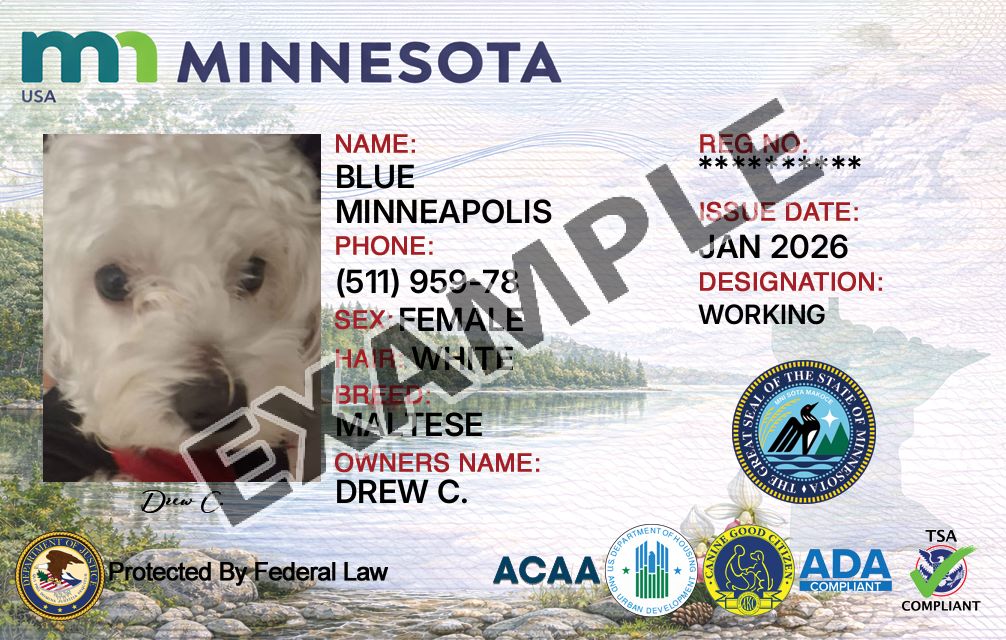
Service Dogs and Emotional Support Animals in Pine, Minnesota
If you’re searching for where do I register my dog in Pine County, Minnesota for my service dog or emotional support dog, the key point is that there are usually two separate tracks: (1) local dog licensing (often handled by a city, township, or animal control authority depending on where you live) and (2) your dog’s service dog or emotional support animal (ESA) status under federal and/or state law. A service dog or ESA typically still needs to follow the same local public-health rules (like rabies vaccination) and any applicable dog license in Pine County, Minnesota requirements.
- Dog licensing is a local government process (commonly city or township, and sometimes handled alongside animal control).
- Service dogs are not “registered” through one universal federal registry. Legal status is based on training and disability-related work/tasks, not an ID card.
- Emotional support animals (ESAs) also are not registered through one universal federal registry; ESA status is usually supported by clinical documentation for specific housing-related situations.
Where to Register or License Your Dog in Pine County, Minnesota
The most verifiable, official licensing information located for Pine County is through municipal offices within the county. If you live inside city limits, the city is often the licensing authority. If you live in a township or unincorporated area, requirements can differ and you may need to confirm the correct licensing point of contact for your specific address.
City of Pine City — City Hall (Dog Registration / City Tag)
Note: Pine City states that a dog license tag follows the rabies vaccination schedule and that a city tag cannot legally be obtained without current rabies vaccination information.
Pine City Township — Town Hall (General Township Contact)
Township requirements can differ from city requirements. If your address is outside city limits, contacting your township is a practical first step to confirm whether your area requires licensing and where it is handled.
Pine County Sheriff’s Office (Non-Emergency) — General Animal Control Guidance
If you are unsure which city/township rules apply to you in Pine County, the non-emergency sheriff contact can help point you to the right local process for an animal control dog license in Pine County, Minnesota (or confirm if your municipality handles licensing directly).
Overview of Dog Licensing in Pine County, Minnesota
What “dog licensing” usually means locally
A local dog license (sometimes called a “dog tag” or “city tag”) is typically a municipal registration that helps your local government: identify a lost dog’s owner, encourage rabies compliance, and support local animal control operations. In many Minnesota communities, the dog tag’s expiration is tied to the rabies vaccination expiration date (for example, when your rabies vaccine is updated, your tag is renewed to match that timeline).
City vs. township rules inside Pine County
Pine County contains multiple jurisdictions. In practice, dog licensing requirements in Pine County, Minnesota may differ based on whether you live:
- Inside city limits (often licensed through City Hall or a city clerk’s office)
- In a township or unincorporated area (rules vary; in some places you may have township rules, and in others the county/sheriff may guide animal control concerns)
Because these rules can change and are location-specific, the most accurate approach is to confirm the correct licensing authority for your address before submitting paperwork or fees.
What You Need Before Registering a Dog
Common documents and information
While exact requirements vary by jurisdiction, most local licensing offices will ask for:
- Proof of current rabies vaccination (certificate or rabies tag details)
- Owner contact details (name, address, phone; sometimes email)
- Dog details (name, sex, breed, color/markings)
- Veterinary clinic information (often requested on forms)
- Spay/neuter status (may affect the fee in some jurisdictions)
Rabies vaccination and why it matters
In many local programs, rabies compliance is central: a dog license may not be issued without current rabies vaccination information. Even if you are registering a service dog or an emotional support animal, local rabies rules and licensing policies generally still apply because they relate to public health and identification.
Steps to Register or License a Dog in Pine County, Minnesota
Step 1: Identify your licensing authority by address
Start by confirming whether your residence is inside a city that issues licenses (for example, Pine City residents can work with Pine City City Hall). If you are outside city limits, check with your township office or ask the sheriff’s non-emergency line to help direct you to the correct local office.
Step 2: Gather rabies vaccination details
Have your rabies certificate or tag information ready. Some offices will ask for the rabies tag number and expiration date so they can align the dog license/tag expiration to match.
Step 3: Complete the application and submit it
Depending on your local office, you may be able to submit information in person, by mail, or through an online form. If you submit by mail, include any required copies of vaccination paperwork and make sure your contact details are clear so staff can reach you if anything is missing.
Step 4: Keep the tag information current
If your rabies vaccination is updated, your license/tag may also need to be updated. Keep your contact information current so animal control or city staff can quickly reunite you with your dog if it’s found.
Service Dog Laws in Pine County, Minnesota
There is no single “official federal service dog registry”
Service dogs are generally recognized based on what the dog is trained to do for a person with a disability (work or tasks directly related to the disability). This is separate from local dog licensing. You can have a fully legitimate service dog and still need to follow local rules for a dog license in Pine County, Minnesota, especially where the local license is tied to rabies vaccination and identification.
Local licensing vs. service dog status
A local license/tag is typically about identification and public health, not whether the dog is a service animal. In other words, licensing does not “make” a dog a service dog; it simply records the dog locally and provides a tag/number for identification purposes.
Comparison: Dog license vs. service dog vs. emotional support animal
| Category | Dog License (Local) | Service Dog | Emotional Support Animal (ESA) |
|---|---|---|---|
| What it is | A local government registration/tag for a dog living in a jurisdiction. | A dog trained to do specific work/tasks for a person with a disability. | An animal that provides emotional support; status is generally relevant to certain housing contexts. |
| Who issues it | Typically your city or township (varies by where you live within Pine County). | No universal federal registry; status is based on training and the handler’s disability-related needs. | No universal federal registry; documentation is typically provided by a healthcare professional when applicable. |
| Common proof requested | Rabies vaccination details; owner contact info; dog description; fee payment. | Usually not an ID card; legitimacy depends on the dog performing trained tasks. | Often a letter/documentation for qualifying housing accommodations (requirements can vary). |
| Main purpose | Public health and identification (lost pet return, animal control, rabies compliance). | Access and assistance related to a disability. | Support for emotional/mental health needs in limited legal contexts (commonly housing). |
| Does it replace a local license? | Not applicable. | Usually no. A service dog may still need a local license/tag if your jurisdiction requires it. | Usually no. An ESA may still need a local license/tag if your jurisdiction requires it. |
Emotional Support Animal Rules in Pine County, Minnesota
ESA status is different from service dog status
An emotional support animal (ESA) is not the same as a service dog. ESAs typically do not have the same public-access status as service dogs. However, an ESA can still be a dog that must follow local animal control rules, including rabies vaccination rules and any applicable local licensing.
Local licensing still focuses on public health and identification
If your local jurisdiction requires licensing, it generally applies to dogs regardless of whether they are pets, ESAs, or service dogs. Think of licensing as the local baseline requirement: it helps ensure rabies compliance and helps local officials identify the owner of a dog if it’s found running at large.
Frequently Asked Questions
Register A Dog In Other Minnesota Counties
Select your county below to get started with your dog’s ID card. Requirements and license designs may vary by county, so choose your location to see the correct options and complete your pup’s registration.
- Aitkin County Dog Registration
- Anoka County Dog Registration
- Becker County Dog Registration
- Beltrami County Dog Registration
- Benton County Dog Registration
- Big Stone County Dog Registration
- Blue Earth County Dog Registration
- Brown County Dog Registration
- Carlton County Dog Registration
- Carver County Dog Registration
- Cass County Dog Registration
- Chippewa County Dog Registration
- Chisago County Dog Registration
- Clay County Dog Registration
- Clearwater County Dog Registration
- Cook County Dog Registration
- Cottonwood County Dog Registration
- Crow Wing County Dog Registration
- Dakota County Dog Registration
- Dodge County Dog Registration
- Douglas County Dog Registration
- Faribault County Dog Registration
- Fillmore County Dog Registration
- Freeborn County Dog Registration
- Goodhue County Dog Registration
- Grant County Dog Registration
- Hennepin County Dog Registration
- Houston County Dog Registration
- Hubbard County Dog Registration
- Isanti County Dog Registration
- Itasca County Dog Registration
- Jackson County Dog Registration
- Kanabec County Dog Registration
- Kandiyohi County Dog Registration
- Kittson County Dog Registration
- Koochiching County Dog Registration
- Lac qui Parle County Dog Registration
- Lake County Dog Registration
- Lake of the Woods County Dog Registration
- LeSueur County Dog Registration
- Lincoln County Dog Registration
- Lyon County Dog Registration
- Mahnomen County Dog Registration
- Marshall County Dog Registration
- Martin County Dog Registration
- McLeod County Dog Registration
- Meeker County Dog Registration
- Mille Lacs County Dog Registration
- Morrison County Dog Registration
- Mower County Dog Registration
- Murray County Dog Registration
- Nicollet County Dog Registration
- Nobles County Dog Registration
- Norman County Dog Registration
- Olmsted County Dog Registration
- Otter Tail County Dog Registration
- Pennington County Dog Registration
- Pipestone County Dog Registration
- Polk County Dog Registration
- Pope County Dog Registration
- Ramsey County Dog Registration
- Red Lake County Dog Registration
- Redwood County Dog Registration
- Renville County Dog Registration
- Rice County Dog Registration
- Rock County Dog Registration
- Roseau County Dog Registration
- Scott County Dog Registration
- Sherburne County Dog Registration
- Sibley County Dog Registration
- St. Louis County Dog Registration
- Stearns County Dog Registration
- Steele County Dog Registration
- Stevens County Dog Registration
- Swift County Dog Registration
- Todd County Dog Registration
- Traverse County Dog Registration
- Wabasha County Dog Registration
- Wadena County Dog Registration
- Waseca County Dog Registration
- Washington County Dog Registration
- Watonwan County Dog Registration
- Wilkin County Dog Registration
- Winona County Dog Registration
- Wright County Dog Registration
- Yellow Medicine County Dog Registration